
Failing an MOT is more common than most drivers expect — roughly 3 in 10 cars fail first time, often on something simple like a blown bulb or a worn wiper blade. The tester hands you a VT30 refusal notice listing every defect. It feels stressful, but a fail is a diagnosis, not a disaster: this guide walks you through the retest rules (which many older guides get wrong), the fees, and your rights.
What the VT30 Failure Notice Tells You
When your vehicle fails, the test station issues a VT30 — a formal “refusal of an MOT test certificate”. Keep it safe: you need it to book a retest and, if you dispute the result, to lodge an appeal. The notice lists every defect found, grouped by severity, plus any advisories — issues that passed this time but will likely need attention soon. Read it carefully before agreeing to any repair work, and check the failure is recorded correctly on your official MOT history online.
The Four Defect Categories — and What Each Means for You
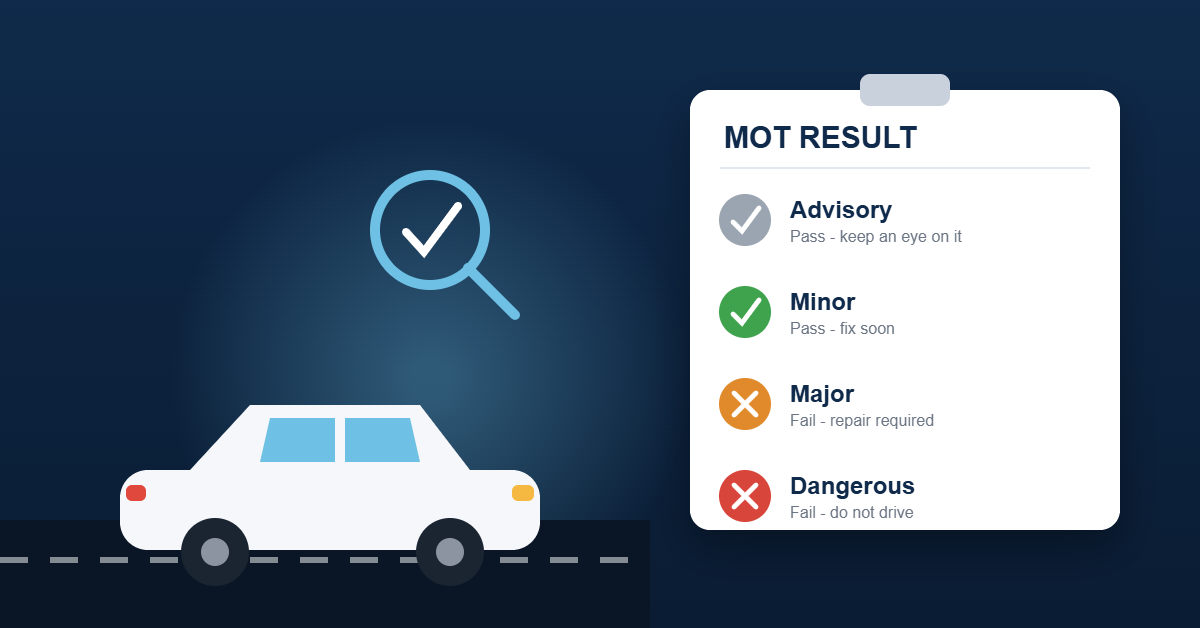
Every fault the tester finds is placed into one of four categories. Understanding them is essential, because the category decides whether your car failed — and whether you can legally drive it home.
| Category | Test result | Can you drive? | What it means |
|---|---|---|---|
| Advisory | Pass | Yes | An issue the tester noticed that is not a failure yet — typically wear that will need attention in the future. |
| Minor | Pass | Yes | A small fault with no significant safety risk. The car passes, but the fault should be repaired as soon as possible. |
| Major | Fail | It depends — see below | A fault that could affect safety, the environment, or put other road users at risk. |
| Dangerous | Fail | No — not until repaired | A direct and immediate risk to road safety or a serious environmental impact. |
The distinction between major and dangerous is the one that matters most. A major defect means the car failed, but whether you can drive it depends on the rules below. A dangerous defect means the vehicle must not be driven at all until it is fixed — not even to get it home.
Can You Still Drive After Failing?
This is the question almost every driver asks first, and the answer depends on two things: whether your old MOT certificate is still valid, and whether any fault was marked dangerous.
- Old certificate still valid and no dangerous defects: you may continue to drive until the old certificate expires — but the car must still be kept roadworthy, and you should get the faults fixed promptly.
- Any fault marked dangerous: you must not drive the vehicle at all until it is repaired — not even home — except for the two narrow exceptions below.
- No valid MOT (expired, or the car never had one): you must not drive, except for the two narrow exceptions below.
There are only two narrow exceptions that allow driving without a valid MOT:
- Driving to a pre-booked MOT test appointment.
- Driving to or from a pre-arranged repair appointment.
The key words are pre-booked and pre-arranged. Driving around “looking for a garage” does not count, and if you are stopped you will have no defence. Book first, drive directly there, and keep proof of the booking with you.
Retest Rules: What You Actually Pay
This is where many older guides go wrong. The current DVSA retest rules are straightforward — what you pay depends on where the car is repaired and how quickly it comes back:
| Situation | What you pay for the retest |
|---|---|
| Free partial retest — the vehicle stays at the test station for repair and is retested within 10 working days | Nothing |
| Half-fee partial retest — you take the vehicle away but return it to the same station within 10 working days | Up to half the full test fee |
| Full retest — you return after 10 working days, or you go to a different test station | The full test fee again |
Two important limits to know:
- Only one partial retest is allowed per full MOT test. If the car fails its retest, the next test must be a full MOT at the full fee.
- The 10-working-day window is strict. Count from the date of the failed test — weekends and bank holidays do not count — and ask the station to confirm the exact deadline in writing.
A partial retest only re-examines the items that failed (plus anything the tester considers affected by the repair) — it is not a full second test. That is exactly why it costs less.
How Much the Fees Are: The Legal Maximums
MOT fees are capped by law — test stations may charge up to the maximum but are free to charge less, and many do. The maximums are:
| Vehicle class | Maximum full-test fee | Maximum half-fee retest |
|---|---|---|
| Class 4 — cars, motor caravans, small goods vehicles | £54.85 | £27.43 |
| Class 1 & 2 — motorcycles | £29.65 | £14.83 |
The £54.85 maximum for a car has been frozen since 2010, so in real terms the test has never been cheaper. Note that no VAT is charged on the MOT test fee itself — the fee is the fee. Any station charging above the cap is breaking the rules.
What Affects Your Retest Cost
- Where the repairs happen. Leaving the car at the test station is the only route to a free retest — but compare the station’s repair quote first; a free retest is no bargain if the labour is overpriced.
- How quickly you return. Miss the 10-working-day window and you pay for a full test, however minor the original failure was.
- Same station or a different one. Retests at a different station are always charged at the full fee — there is no half-price option elsewhere.
- The station’s own pricing. Many garages charge less than the legal maximum, and some include a free retest when they do the repair work. Always ask for the total cost — parts, labour, and any retest fee — before authorising work.
How to Appeal a Result You Disagree With
If you genuinely believe the failure was wrong — not just unwelcome — you can appeal to the DVSA. This is a formal process with strict rules, and it only works if the vehicle has not been touched since the test.
- Tell the test station at the time that you intend to contest the result.
- Complete form VT17 (the DVSA’s complaint-about-an-MOT form) and send it to the DVSA within 14 working days of the test. Include as much evidence as you can — the VT30, photographs, and references to the specific defects.
- Wait for the DVSA’s response. The DVSA will contact you within 5 days to discuss your appeal. If they decide your vehicle needs rechecking, you will arrange a date for the re-examination.
- Pay the full test fee again. The appeal retest is charged at the full MOT fee — you pay it upfront. If your appeal is successful, the fee is refunded (in full or in part).
- Do not repair or alter the vehicle before the appeal retest. It must be in exactly the same condition as when it was tested — any repair work cancels the appeal.
Be realistic: appeals succeed only where the original decision was genuinely wrong, and the vehicle must stay off the road in the meantime. For most drivers, getting the fault fixed and taking the standard retest is faster and cheaper. You can read the official process on GOV.UK’s MOT pages.
What Happens If You Ignore the Failure
A failed MOT is not advice — it is a legal finding. Ignoring it carries real consequences:
- A fine of up to £1,000 for driving without a valid MOT when one is required.
- Much harsher penalties for dangerous defects — fines of up to £2,500, penalty points, and in serious cases a driving ban.
- Invalid insurance. Most policies require the vehicle to be roadworthy with a valid MOT where one is required. If you have an accident while driving on a failed MOT, your insurer can refuse the claim — leaving you personally liable for the damage.
- Automatic detection. Police ANPR cameras flag vehicles with no valid MOT, so you do not need to be stopped for another reason to be caught.
Your Post-Failure Checklist
- Keep the VT30 somewhere safe — you need it for the retest or an appeal.
- Read the defects properly. Separate dangerous faults (fix immediately, do not drive) from major faults, and note any advisories for future maintenance.
- Decide where to repair. Get a written quote from the test station and compare it with an independent garage — factor in the retest fee each option triggers.
- Watch the 10-working-day clock. Note the deadline the day you fail; missing it turns a cheap retest into a full-price test.
- Get the work done and retested. Keep the invoice as proof of repair — it also helps when you eventually sell the car.
- Fix this year’s advisories before they become next year’s failures. Our 10 pre-MOT checks show how to catch them early, and our common MOT failures guide explains what testers flag most.
- Set a reminder for next year. See our MOT due date guide so you never face a last-minute scramble again.
Related Reading
- MOT Guide: Everything UK Drivers Need to Know — the full overview of the test, costs, and your responsibilities.
- Common MOT Failures — what cars most often fail on, and how to avoid it.
- 10 MOT Check Tips to Avoid Failing — simple checks to do before test day.
- MOT History Check — see your vehicle’s full test record, including this failure.
Frequently Asked Questions
How long do I have to get my car retested?
You have 10 working days from the failed test to qualify for a free or half-fee partial retest at the same station. After that, it is a full test at the full fee.
Is the retest always free?
No. The retest is only free if the vehicle stays at the test station for repair and is retested within 10 working days. Take it away and return it to the same station within 10 working days and you can be charged up to half the test fee.
How many retests can I have?
Only one partial retest per full MOT test. If the car fails the retest, the next test must be a full MOT at the full fee.
Can I take my car to a different garage for the repairs?
Yes — but if you take the car away, the cheapest retest available is the half-fee partial retest at the same test station within 10 working days. A different station means a full-price test.
How much does it cost to appeal an MOT failure?
The appeal retest is charged at the full MOT fee, which you pay upfront. If your appeal succeeds, the fee is refunded.
Does a failed MOT show on the vehicle’s history?
Yes. Every test result — pass or fail — is recorded against the registration on the official MOT history, visible to future buyers through a free MOT history check.
Can I sell a car that has failed its MOT?
Yes, there is no law against selling a car without a valid MOT — but you must not misrepresent it, the buyer cannot legally drive it away (except to a pre-booked test or repair), and the failure is visible on its MOT history.
Conclusion
A failed MOT is inconvenient, but the system is designed to get you back on the road quickly and fairly: repair the faults, return within 10 working days, and your retest costs nothing or at most half the fee. Know the defect categories, respect the difference between major and dangerous faults, never drive when you should not, and use the VT30 and your retest window wisely. And once you are through it, a few minutes of pre-test checks each year — plus a reminder set well before your due date — will make next year’s test far less dramatic.