
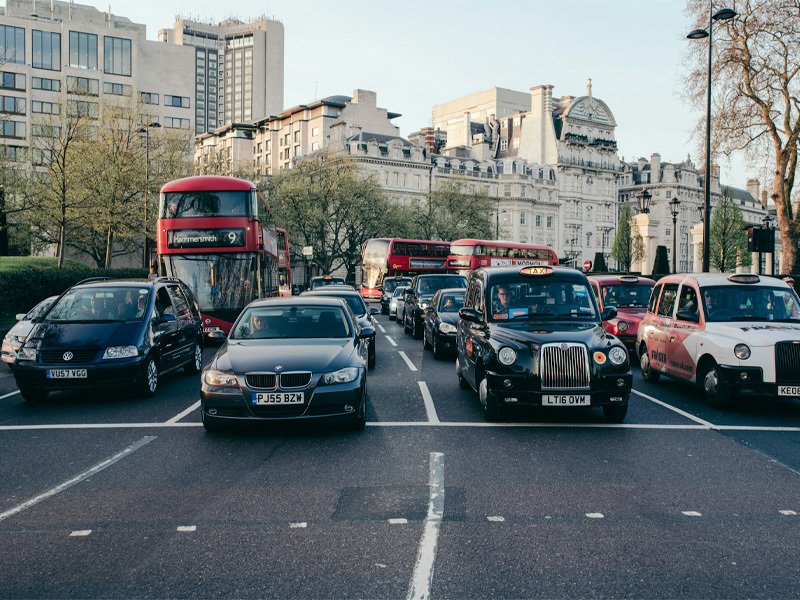
If you drive in Britain, keeping to the left feels as natural as breathing. You do it without thinking, the same way you reach for the gear stick with your left hand and grumble about roundabouts. Then you cross the Channel, pick up a hire car, and suddenly you are the odd one out. Around 75 countries and territories still drive on the left, but most of the rest of the world does not, and that mismatch catches out more holidaymakers than almost anything else on the road.
This is the full list, why it happened that way, and what it means for you the next time you drive somewhere unfamiliar.
The full list: every country that drives on the left
Counting exactly is trickier than it looks. The total comes to around 75, and the exact number depends on whether you count places like Guernsey and Jersey separately and how you treat disputed territories. What follows is the most widely accepted list, grouped by region.
Europe (7)
- United Kingdom
- Ireland
- Malta
- Cyprus
- Isle of Man
- Guernsey
- Jersey
Northern Cyprus also drives on the left, although its status as a separate state is disputed, so it rarely appears in official counts.
Asia (16)
- Bangladesh
- Bhutan
- Brunei
- Hong Kong
- India
- Indonesia
- Japan
- Macau
- Malaysia
- Maldives
- Nepal
- Pakistan
- Singapore
- Sri Lanka
- Thailand
- Timor-Leste
Hong Kong and Macau are the interesting pair here. Both drive on the left while mainland China drives on the right, which makes for some careful bridge and border design where the two systems meet.
Africa (15)
- Botswana
- Eswatini
- Kenya
- Lesotho
- Malawi
- Mauritius
- Mozambique
- Namibia
- Seychelles
- South Africa
- Tanzania
- Uganda
- Zambia
- Zimbabwe
- Saint Helena
Oceania (17)
- Australia
- New Zealand
- Papua New Guinea
- Fiji
- Solomon Islands
- Kiribati
- Nauru
- Tonga
- Tuvalu
- Samoa
- Cook Islands
- Christmas Island
- Cocos (Keeling) Islands
- Norfolk Island
- Niue
- Tokelau
- Pitcairn
Americas and the Caribbean (20)
- Anguilla
- Antigua and Barbuda
- Bahamas
- Barbados
- Bermuda
- British Virgin Islands
- Cayman Islands
- Dominica
- Grenada
- Jamaica
- Montserrat
- Saint Kitts and Nevis
- Saint Lucia
- Saint Vincent and the Grenadines
- Trinidad and Tobago
- Turks and Caicos
- US Virgin Islands
- Guyana
- Suriname
- Falkland Islands
A few traps are worth knowing. You will sometimes see lists claiming 76 countries, but those usually include Somalia, which actually drives on the right. British Somaliland once drove on the left, but that ended when it united with Italian Somaliland. And not every British territory kept to the left: Gibraltar and the British Indian Ocean Territory both drive on the right. Then there is the odd case of the US Virgin Islands, the Bahamas, the Cayman Islands, the British Virgin Islands and Turks and Caicos. They drive on the left, but most of the cars on their roads are left-hand-drive imports from the United States, so the driver sits on the “wrong” side for the road. It works, after a fashion, because the roads are small and the traffic is slow.
Why do these countries drive on the left?
The short answer is the British Empire. Britain kept to the left, and the rule travelled with its administrators, soldiers and engineers to India, Malaya, Hong Kong, East Africa, the Caribbean and the Pacific. One of the earliest keep-left laws anywhere was for London Bridge in 1756, back when the problem was horse-drawn carts rather than cars.
After independence, most former colonies simply kept the system they had. Switching sides is enormously expensive and disruptive. Every road sign has to move, every junction has to be redesigned, bus stops end up on the wrong side of the road, and the entire national car fleet is suddenly built for the other side. For most countries, there was never a good enough reason to pay that bill.
You have probably heard that Napoleon imposed right-hand driving on Europe as his armies marched across it. It is a good story, and it gets repeated everywhere, but historians have found no documentary evidence for it. Treat it as a myth, not as history.
Japan: the exception that was never a colony
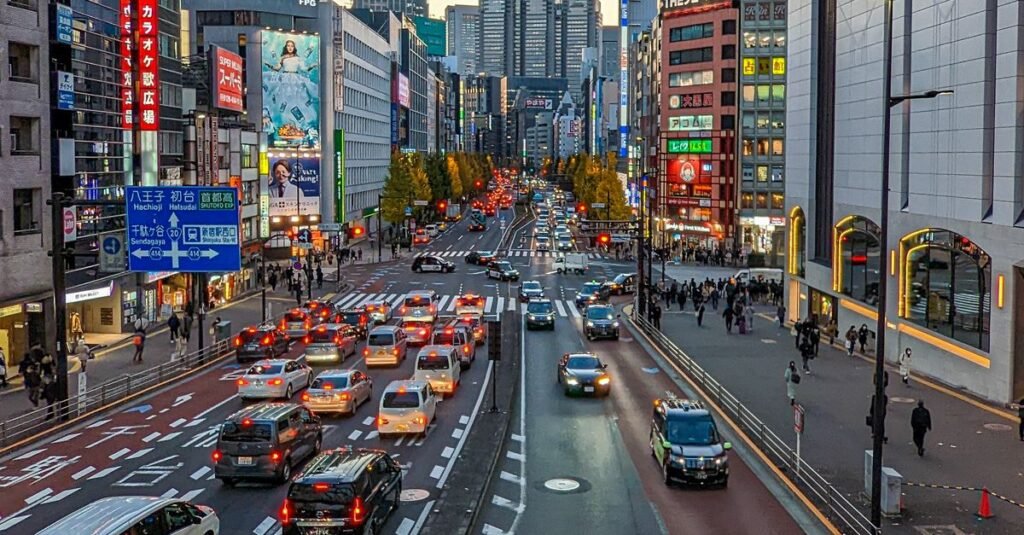
Japan is the one big name on the list that the British Empire cannot explain, because Japan was never a British colony at all. The habit goes back much further than cars. In the Edo period, samurai carried their swords on the left hip, so they kept to the left of the road to stop their scabbards clashing with passers-by. When British engineers built Japan’s first railway in 1872, it ran on the left too, and road traffic was legally fixed to the left in 1924.
Okinawa is the footnote that proves the rule. It drove on the right while under American administration after the Second World War, then switched back to the left on 30 July 1978 when it returned to Japanese control. Changing sides twice in a lifetime is rare. Okinawa managed it.
The two countries that actually switched sides
Almost nobody switches. In living memory, only two countries have done it, and both stories show why everyone else stays put.
Sweden drove on the left from the 1700s, even though around 90 percent of Swedish cars were already left-hand-drive and every neighbouring country drove on the right. In a 1955 referendum, 83 percent of voters said no to switching. Parliament legislated for it anyway in 1963, and on Sunday 3 September 1967, known as Dagen H, the whole country changed over. Traffic stopped at 04:50 in the morning, around 350,000 road signs were swapped, and at 05:00 everyone set off on the other side of the road. Accidents actually fell at first, then settled back to normal. Sweden is the textbook case for how a switch can work, and also for how much political nerve it takes.
Samoa went the other way. It had driven on the right for over a century, then switched to the left at 06:00 on Monday 7 September 2009. The reason was practical rather than patriotic: Samoa wanted cheaper right-hand-drive cars imported from Australia, New Zealand and Japan. The government declared public holidays for 7 and 8 September, banned alcohol sales for three days, and pushed through protests that had drawn around 18,000 people onto the streets of Apia the year before. A legal challenge failed, and the switch went ahead. No country has switched sides since.
A handful of others made the change in earlier decades, all from left to right: Finland in 1858, Iceland in May 1968, Nigeria on 2 April 1972, Ghana in 1974, and Myanmar on 6 December 1970. Myanmar is a curiosity worth remembering, because it still runs mostly right-hand-drive cars on right-hand roads, which tells you how long a national car fleet takes to catch up with a decision made at a border post.
“Left hand drive countries”: what people actually mean
This is where the search terms get tangled, and it is worth untangling, because the two phrases sound almost identical and mean opposite things.
Left-hand traffic means cars keep to the left side of the road. Left-hand drive means the steering wheel sits on the left side of the car. In normal use, the two go together in reverse: countries with left-hand traffic almost always use right-hand-drive cars, and countries with right-hand traffic use left-hand-drive cars. The reason is simple. The driver sits by the centre line, so they can see past the vehicle in front before overtaking. Roundabouts follow the same logic in reverse: clockwise where traffic keeps left, counter-clockwise where it keeps right.
So when someone types “left hand drive countries” into a search engine, they almost always mean the list on this page: the UK, Japan, Australia, Jamaica and the rest of the left-traffic world. Taken literally, the phrase means the opposite set: the United States, France, Germany and most of the planet. If you ever wondered why search results for that phrase seem to disagree with each other, that is why.
Driving abroad as a UK driver: what to sort before you go
Most UK drivers first meet right-hand traffic at a hire car desk, which is actually the easiest version of the problem. Hire a left-hand-drive car where you land if you can. Taking your own right-hand-drive car abroad is legal in most places, but overtaking on the right while sitting on the left is miserable, because you are on the wrong side to see past the vehicle in front. If you do take your own car, the paperwork matters more than the driving.
Start with the headlights. UK headlights dip to the left, which means they dazzle oncoming drivers on the right. Fit beam deflectors, or use the menu setting if your car has one, before you leave. Next, the speedometer. The UK uses miles per hour, but almost everywhere else uses kilometres per hour, so switch a digital display to km/h and learn the rough conversions if your dials are analogue. You will also need a UK sticker on the back of the car unless your number plate already carries the UK identifier.
On documents, a UK photocard licence is enough across the EU, Switzerland, Norway, Iceland and Liechtenstein. If you still hold a paper licence, or your licence was issued in Gibraltar, Guernsey, Jersey or the Isle of Man, you may need an International Driving Permit. There are three types, 1926, 1949 and 1968, and the one you need depends on the country. A permit costs £5.50 from shops with PayPoint, and it only works alongside your actual licence, never instead of it. A 1926 or 1949 permit lasts 12 months, while a 1968 permit lasts three years or until your licence expires, whichever comes first. Take your V5C log book for your own car, or a VE103 certificate if the car is hired or leased. And check your insurance before you assume anything: you do not need a Green Card for the EU, the EEA, Switzerland and several other European countries, but you may need one for Turkey, Morocco, Ukraine and a handful of others, so ask your insurer rather than guessing. UK cover also defaults to third-party-only abroad unless you have extended it, which is a nasty surprise to discover after an accident.
Tolls and clean air rules are the other things people forget. Some toll roads take cash or card at a booth, others use a transponder, and several countries require a vignette bought in advance from an official site, not a reseller. France’s Crit’Air sticker and similar low-emission-zone permits fall into the same category: cheap from the official source, expensive and stressful if you leave it to the last minute. If you are hiring, ask the company whether you need a licence check code, which you can get up to 21 days before you pick the car up, and confirm exactly what their insurance covers.
One last job before any long trip, and it has nothing to do with borders. Make sure the car itself is roadworthy. The faults in our most common MOT failures guide are the same ones that strand people hundreds of miles from home, and our MOT guide explains what testers actually check. A car that would pass its MOT at home is a car you can trust abroad.
The mistakes that catch UK drivers out
Almost every experienced driver who has done this will tell you the same thing: the dangerous moment is not the first junction, when you are concentrating hard. It is the moment you stop concentrating. Pulling out of a fuel station or a car park, chatting to a passenger, following a sat nav instruction, and suddenly you have drifted back to the left out of pure habit. Roundabouts are the second trap. On the right, they run counter-clockwise and you give way to the left, which is the exact mirror image of home, and your instincts will fight you for the first few days. Then there is looking the wrong way at junctions, overtaking on the wrong side, and motorway lane discipline, where you keep right except to overtake instead of keeping left. None of it is difficult. All of it is unnatural until it is not, and that gap is where mistakes happen.
Visiting the UK? The mirror image
Everything above works in reverse if you are coming to Britain. Visitors can usually drive on a full overseas licence for up to 12 months, and hire cars here are right-hand-drive, so the pedals and the gear stick will feel familiar even if the side of the road does not. Speeds are in miles per hour: 30 in built-up areas, 60 on single carriageways, 70 on dual carriageways and motorways, with plenty of 20 zones in towns. Roundabouts go clockwise and you give way to the right. If you are moving to the UK rather than visiting, different rules apply, so check the GOV.UK guidance for your situation rather than relying on the visitor rules.
Frequently asked questions
How many countries drive on the left?
Around 75 countries and territories, depending on how you count places like Guernsey and Jersey and disputed territories. The number is sometimes quoted as 76, but those lists usually include Somalia, which drives on the right.
Is the UK the only country in Europe that drives on the left?
No. Ireland, Malta and Cyprus drive on the left too, along with the Isle of Man, Guernsey and Jersey. Everywhere else in Europe drives on the right, which is why the first hour of a continental road trip feels so strange.
Do countries that drive on the left use right-hand-drive cars?
Almost always, because the driver sits by the centre line for a clear view when overtaking. The exceptions are places like the US Virgin Islands and the Bahamas, which drive on the left but mostly run left-hand-drive cars imported from the United States.
What does “left hand drive countries” mean?
Usually, people searching that phrase mean the countries on this page: the UK, Japan, Australia and the rest of the left-traffic world. Taken literally, though, it means the opposite: countries where the steering wheel is on the left, which is most of the planet, including the United States, France and Germany.
Can I drive my UK car in Europe?
Yes, with the right preparation. You need beam deflectors, a UK sticker unless your plate already carries the UK identifier, your V5C, and insurance that actually covers you abroad. A photocard licence is enough in the EU and several other countries, but paper licence holders may need an International Driving Permit.
Has any country switched sides recently?
Not since Samoa switched from right to left in 2009. Rwanda and Burundi have discussed switching to the left to match their East African neighbours, but Rwanda has decided to stay on the right because of the cost, so there is no switch on the horizon.
So the next time someone asks what countries drive on the left side of the road, you have the answer, and it is longer than most people expect. Around 75 of them, spread across every continent except Antarctica, held together mostly by an empire that no longer exists and a switching bill nobody wants to pay. If you are planning to drive in any of them, or in the much larger part of the world that drives on the right, sort the paperwork before you go, and check your MOT history so there are no surprises waiting for you on the driveway.
Sources: Wikipedia’s “Left- and right-hand traffic”, Frommer’s list of left-driving countries, MoneySuperMarket, and GOV.UK driving abroad guidance.